Through the Osher Lifelong Learning Institute (OLLI) Scholars program, University of Delaware graduate students translate their research and its real-world impact into engaging courses for OLLI’s vibrant learning community. In these classrooms, scholarship meets lived experience.
How communities experience disasters
Sydney Dyck, a doctoral student in sociology, designed her course directly from her research on how communities respond to crises.
“My course was ‘Sociology of Disasters,’” she said. “I focus on disasters and community outcomes specifically.”
In the classroom, discussions moved between large-scale events and the everyday realities that shape how people experience them. Discussions included Hurricane Katrina and wildfires in the United States and Canada, along with more specific considerations that are often overlooked.
“We talked about things like pets and companion animals, livestock, and where they go during an evacuation,” she said. “We’ve talked about people with disabilities or mobility issues, how they are included in evacuation planning, and language accessibility, like how to communicate with people who may not speak English as their primary language.”
To deepen that understanding, Dyck introduced sociological frameworks that challenge assumptions about disasters.
“We did an activity where everyone thought about how they would describe a disaster and what that included,” she said. “The gist was to show there is no universal understanding of what a disaster is or what it looks like.”
Those conversations take on an added depth in the OLLI classroom, where many participants bring professional and lived experience.
“A lot of them have been involved with emergency management or response in their careers,” Dyck said. “So people bring really good input, like ‘I worked for DuPont, and these were the steps we took during a chemical emergency.’”
In a session on social vulnerability, Dyck led a pod mapping exercise to help learners think through their personal support systems.
“If there was a disaster, who around you would you go to for help?” she said. “Do you have neighbors or family nearby, or someone with the tools you might need?”
The exercise prompted reflection and practical planning.
“It was about thinking through your own vulnerability ahead of time,” Dyck said, “so if something happens, you know who to call and what support you have in place.”
Finding chemistry in everyday experiences
Mabee, a graduate student working at the intersection of chemistry and synthetic biology, designed his course, “Chemistry in the Kitchen,” to translate his research into everyday contexts familiar to OLLI learners.
“My main goal with this course is to really marry both chemistry and food science or cooking,” Mabee said.
His research focuses on breaking down plastics using biological processes, particularly by studying organisms that can degrade plastic and exploring how those systems might be used to turn waste into useful materials. In the classroom, he connects that research to common experiences, helping learners see how scientific concepts apply beyond the lab.
“A lot of people think of science as only professional, but it really crops up in something very common and every day,” he said. “I’m trying to get them to think more scientifically about everyday things.”
The course reflected both Mabee’s research and his interest in outreach. He has visited schools and participated in a chemistry ambassador program, experiences that shaped how he approaches teaching broader audiences. That background is especially relevant in an OLLI classroom, where many learners bring strong educational and professional experience.
“A lot of people in this area are chemical professionals or have worked in technical fields,” Mabee said. “So my hope is that people who are interested in cooking can better understand the chemistry, and people with a chemistry background can see it in a different context.”
Course topics ranged from the science of water to the chemistry behind freezing and food preparation. Even simple processes become opportunities to explore deeper concepts.
“We have all these observations in daily life, but we don’t always think about what’s going on at the molecular level,” he said.
By connecting research to familiar experiences, Mabee’s course invites learners to see how scientific thinking shapes the world around them.
Inside the criminal legal system
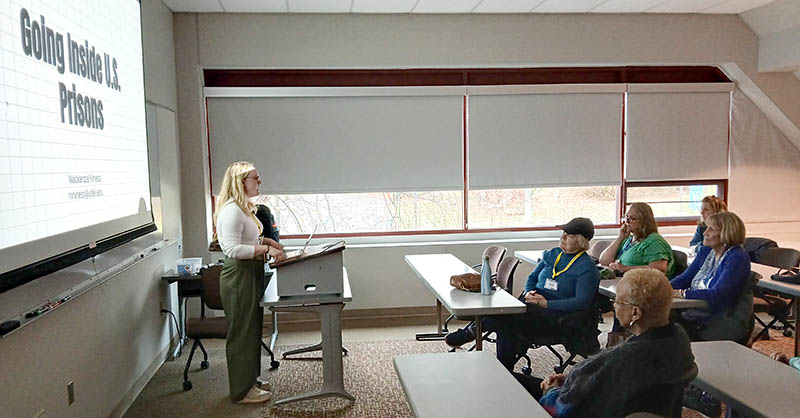
Niness, a doctoral student studying the criminal legal system, designed her course, “Going Inside U.S. Prisons,” to translate her research and teaching experience into a classroom setting for OLLI learners.
“I really wanted to let people know what the basics are,” she said. “What do we need to know about prison systems and the criminal legal system, and what do we need to know about Delaware specifically?”
Her course drew on research with formerly incarcerated women and her experience teaching in and around correctional facilities. That work informed both the structure of the course and the topics it explored, from system organization to disparities in how people experience incarceration.
“There are a lot of misconceptions about the criminal legal system,” Niness said. “I wanted to give people good data up front so we can have really informed opinions about how things are going.”
She grounded discussions in research and data, including accessible resources learners could return to after the course. At the same time, she introduced broader frameworks for understanding the system, including how shared values shape perspectives on incarceration.
“I showed people that we might already hold values that align in certain ways,” she said. “Maybe the language is unfamiliar, but the principles are not.”
One class session brought those ideas into sharper focus when Niness invited a formerly incarcerated woman to speak. The guest, who had spent two decades in prison, shared her experiences directly with the group.
“It was so meaningful to have someone speak who they might never otherwise meet,” Niness said. “And to have that perspective come from someone who, as an older person, could be their peer.”
The conversation allowed learners to engage with lived experience alongside research, deepening their understanding of the system.
“I think it helped people see things in a different way,” Niness said. “They were asking thoughtful questions and really engaging with the material.”
By combining research, data and firsthand perspectives, Niness’s course offers a closer look at a complex system while making space for deeper understanding.
OLLI classrooms build teaching experience
Across disciplines, the courses demonstrate how the OLLI Scholars program brings academic research and its real-world impact into the classroom. Whether exploring disasters, everyday chemistry or the criminal legal system, each course translates complex ideas into accessible learning experiences grounded in both research and lived perspective.
For the graduate students, the experience also shapes their futures. Dyck said teaching OLLI learners clarified her interest in academia, while Mabee viewed the program as an opportunity to build teaching experience.
All three emphasized the energy of the classroom, where discussions are driven by curiosity and enriched by the experiences learners bring. OLLI courses create space for dialogue, reflection and shared understanding.
In that environment, teaching becomes more than delivering content. It becomes a way to connect research with real-world context and invite learners in deeper exploration of the ideas shaping their lives.

Osher Lifelong Learning Institute (OLLI) at the University of Delaware
OLLI is an academic cooperative for adults 50 and over to enjoy classes, teach, exchange ideas and socialize together, with no exams or educational requirements for participation. OLLI welcomes you. Kent/Sussex | Wilmington