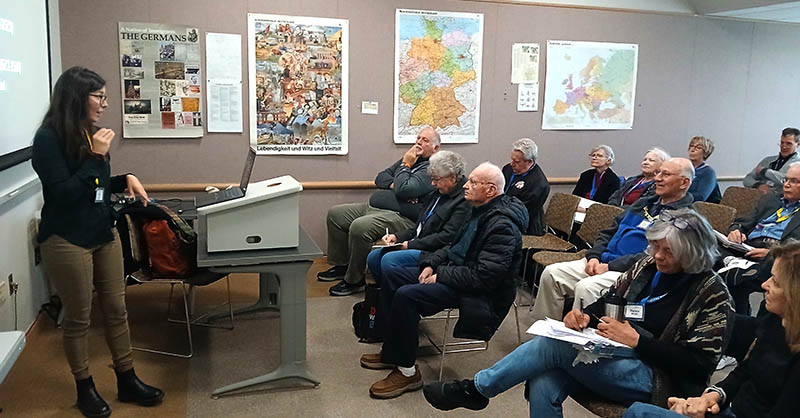
Graduate students at the University of Delaware are finding an uncommon laboratory for teaching through the Osher Lifelong Learning Institute Scholars program: a classroom filled not with undergraduates but with curious, highly engaged adult learners.
For Pamela Ahern and Ayham Ghith, the program offered more than a chance to share specialized knowledge, it provided a space to design courses from scratch, test teaching strategies and develop communication skills that will shape their careers.
A different kind of history class
Ahern, who recently earned her doctorate in history, used the opportunity to teach a course on early modern Scotland, covering the 1600s through the Enlightenment. Her research focuses on Scottish intellectual history, but before joining OLLI Scholars she had not been able to teach a course centered on that subject.
“This was a really great opportunity for me to build a course around exactly what I would prefer to teach,” Ahern said, explaining that her specialty has not usually had a place in the world history and print culture courses she teaches.
Designing the course required condensing centuries of political and cultural change into five sessions. Ahern organized her material around key turning points such as the Scottish Reformation and the Enlightenment while leaving room for discussion.
Unlike a typical undergraduate class, her students brought extensive knowledge and varied professional backgrounds, sometimes including former professors. They asked complex questions, offered insights and helped answer each other’s questions.
“There were moments where I didn’t have the answer,” Ahern said, noting that students were eager to dive into “very particular cases” in Scottish history. “And someone in the class did.”
The dynamic pushed her to rethink her approach. Instead of a one-directional lecture, the class became a collaborative exchange. Topics like witchcraft in Scotland and the life of Mary, Queen of Scots sparked strong interest.
“At times it was intimidating and even a little overwhelming because they were so interested and wanted to do deep dives,” Ahern said. “But it was a great experience to be challenged in that way and think about how to communicate as an instructor when you don’t always have every answer.”
Bringing science to a broader audience
Ghith, a master’s student in the medical molecular sciences program, taught a course titled “Medicine Beyond Earth,” an introduction to aerospace medicine and how the human body responds to spaceflight. His academic research focuses on clinical trials examining nutritional supplements and their effects on cardiovascular and bone health in older adults, but the OLLI course allows him to explore a different scientific interest.
“The course examined how the human body is affected when it leaves the Earth,” Ghith said, a topic within aerospace medicine.
Ghith designed the class to be accessible to learners with no prior scientific background, focusing on big ideas and real-world applications. Aerospace medicine, he said, is not just about astronauts. Research in the field has practical implications for health care on Earth.
“A lot of what comes out of aerospace medicine research is applied in daily life,” he said.
Ghith said he always knew he wanted to pursue something in the biomedical field, but in college, he discovered how much he enjoyed working as a researcher.
“As I moved along my college career, I really found myself enjoying being a researcher and working in biomedical research,” he said, adding that he hopes to pursue a PhD and a long-term career in the field.
Like Ahern, Ghith sees the program as a chance to build critical teaching experience. He has led chemistry workshops and taught microbiology labs, but OLLI Scholars gives him full responsibility for creating and leading a course.
“I would build upon all of my teaching experience into this mini course that I was able to propose and develop from start to finish,” he said.
He is also incorporating teaching principles such as constructivism, emphasizing building new knowledge on students’ existing experiences.
Where scholarship and curiosity meet
Both scholars highlighted another defining aspect of the program: mentorship. Participants submit proposals and pitch courses to a selection committee. Once selected, they receive guidance from OLLI instructors, receiving feedback from both mentors and students.
“They are very committed to mentoring and supporting you,” Ahern said.
The support, she added, strengthens teaching skills and confidence.
Together, Ahern’s and Ghith’s courses highlight how the OLLI Scholars program brings specialized areas of research to a broad audience.
For graduate students preparing for careers in academia or research, the value is clear. Ahern leaves with a fully developed course on her curriculum vitae, while Ghith gains experience communicating complex science to a broad audience. Together, their courses, spanning early modern Scottish history and aerospace medicine, reflect the wide-ranging interests of OLLI learners.
Beyond those benefits, both emphasize the energy of a highly engaged classroom and the chance to connect across generations through learning.
“It’s just such a different teaching environment,” Ahern said.
In that environment, graduate students are not only instructors but learners themselves, refining their craft through each question, discussion and unexpected insight.

Osher Lifelong Learning Institute (OLLI) at the University of Delaware
OLLI is an academic cooperative for adults 50 and over to enjoy classes, teach, exchange ideas and socialize together, with no exams or educational requirements for participation. OLLI welcomes you. Kent/Sussex | Wilmington