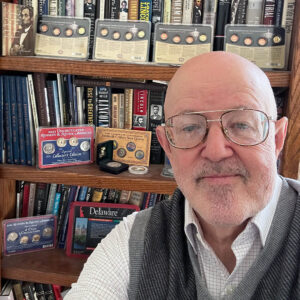
On April 13, from 4 to 5:15 p.m. at the Lewes Public Library, educator and historian Dan Pritchett will present “The Declaration of Independence: What You Didn’t Learn in School,” part of the Lewes250 event series commemorating America’s 250th anniversary.
While the Declaration is often remembered as a political turning point, Pritchett argues its deeper impact lies in how it reshaped the concept of humanity itself, not just in the United States but also beyond. Most Americans believe they know the document well, he said, but few realize just how radical, controversial and fragile its most important words once were.
“The historian Walter Isaacson refers to the Declaration of Independence’s equality clause as ‘the greatest sentence ever written’ in his 2025 book of the same name,” Pritchett said. “’We hold these truths to be self evident, that all men are created equal’ came very close to being discarded more than once. If things had gone just a little differently, the Declaration of Independence might have been forgotten and that idea of equality might have disappeared with it.”
Freedom belongs to everyone
Before 1776, freedom was largely granted by kings to nobles or elites. The Declaration of Independence upended that order by asserting that rights did not come from rulers but belonged inherently to ordinary people. More radically, it defined those rights as universal, rooted in shared human equality rather than privilege, wealth or birth.
“The idea that all people are entitled to the same basic rights really was revolutionary,” Pritchett said. “It wasn’t something everyone agreed with, and it certainly wasn’t something all people were ready to live up to.”
That idea was tested almost immediately. The Declaration faced its first major threat just weeks after its adoption on July 4, 1776. Once Congress declared independence, Britain was expected to respond swiftly, and New York City was the obvious target. Washington’s army of about 19,000 men, many poorly trained and serving short enlistments, was nearly trapped and destroyed at the Battle of Long Island.
“It looked like the war might be over,” Pritchett said. “If the army had been captured or destroyed, the Declaration would have been quickly forgotten.”
A second, more prolonged threat to equality emerged in the mid 1800s, when many Americans openly rejected the idea of human equality. Early leaders had assumed slavery would gradually fade, but instead it became more entrenched. Many Americans in both the North and South dismissed equality as a dangerous error.
“It took a war to save the Declaration,” Pritchett said. “Abraham Lincoln resurrected its meaning of equality at a moment when the nation was drifting away from it.”
Our greatest sentence is still unfinished
Pritchett sees parallels in more recent history as struggles once thought settled return. Each generation, he said, reopens the same question: Do we believe this, or not?
“When the Declaration was written, people focused on Jefferson’s list of grievances against the king,” Pritchett said. “But it’s the preamble that changed our country and the world. Those words have inspired people for 250 years.”
The greatest sentence is still on trial. “The Declaration is a great document,” he said. “Let’s live it.”
About the presenter
Pritchett brings more than four decades of teaching experience to his Osher Lifelong Learning Institute (OLLI) classrooms. He taught eighth grade American history for 34 years in the Capital School District and served for seven years as an adjunct professor at Delaware State University. Since retiring in 2010, he has been a popular OLLI instructor, beginning in 2012 and currently teaching in both Dover and Lewes.
He is known for blending history and music in dynamic courses that weave historical narrative with musical interpretation. His widely popular class on Alexander Hamilton paired Ron Chernow’s biography with selections from the Broadway soundtrack. He continues that creative approach with an upcoming class on the musical 1776 and a well-received course on George Gershwin.
Lewes250 honors 250 years of the American spirit
Pritchett’s Declaration of Independence presentation is part of Lewes250, the community-wide celebration marking America’s 250th anniversary in 2026. Organized by the City of Lewes, Lewes250 includes a yearlong series of events, programs and historical commemorations celebrating the town’s unique role in American history and its connection to the nation’s founding.
 For those interested in related programming, Pritchett will reprise his popular “Delaware in the Revolution — John Dickinson: A New Look” presentation at the Duck Creek Regional Library in Smyrna, Del., on April 21.
Article by Lisa Walenceus

Osher Lifelong Learning Institute (OLLI) at the University of Delaware
OLLI is an academic cooperative for adults 50 and over to enjoy classes, teach, exchange ideas and socialize together, with no exams or educational requirements for participation. OLLI welcomes you. Kent/Sussex | Wilmington